This text is part of an experiment I undertook with Ben Guzovsky; the cited texts are mine, but the material linking those citations is not. If you have landed on this page directly, click here for an introduction and a little context. Thank you! —DGB
The Man Who Hid Inside a Giant Face: How Advertisers Track Attention
Eye tracking is about a century old, and it was built to sell advertising. D. Graham Burnett, a Princeton historian of attention, puts the premise bluntly: “Our eyes are worth money.” His account runs from a 1925 Harlem shop window, where a psychologist hid inside a giant painted face, to today’s attention metrics.
Why do advertisers want to measure attention at all?
Burnett opens his 2023 essay “Fracking Eyeballs” in Asterisk with that sentence, then observes that our economy is “functionally an eyeball economy” and asks: “how did eyeballs come to look like dollar signs?”
His answer is “the original Faustian Bargain,” in which the sciences of perception, armed with “sophisticated technologies of precision monitoring and measurement,” “cut a deal with those who move the money around.” It was, he writes, “a cozy connection warmed across the early decades of the twentieth century,” a “marriage of convenience between American psychologists and American ad-men.” Out of it came “the concatenation of attention and value.”
The traffic ran both ways. In 1895 the Yale psychologist Edward Wheeler Scripture suggested that ad-men were “ahead of laboratory psychologists in the practical understanding (and manipulation) of eyeballs,” with their “deep lay expertise in attention capture.” Harlow Gale at Minnesota answered with what Burnett calls “the earliest documented laboratory experiments on print ads,” built to reproduce, in Gale’s words, “the conditions of rapidly turning the leaves of a magazine.” By 1900 the lab had turned to the “attention value” of “particular parts of a page, of particular kinds of font, and of various hues.”

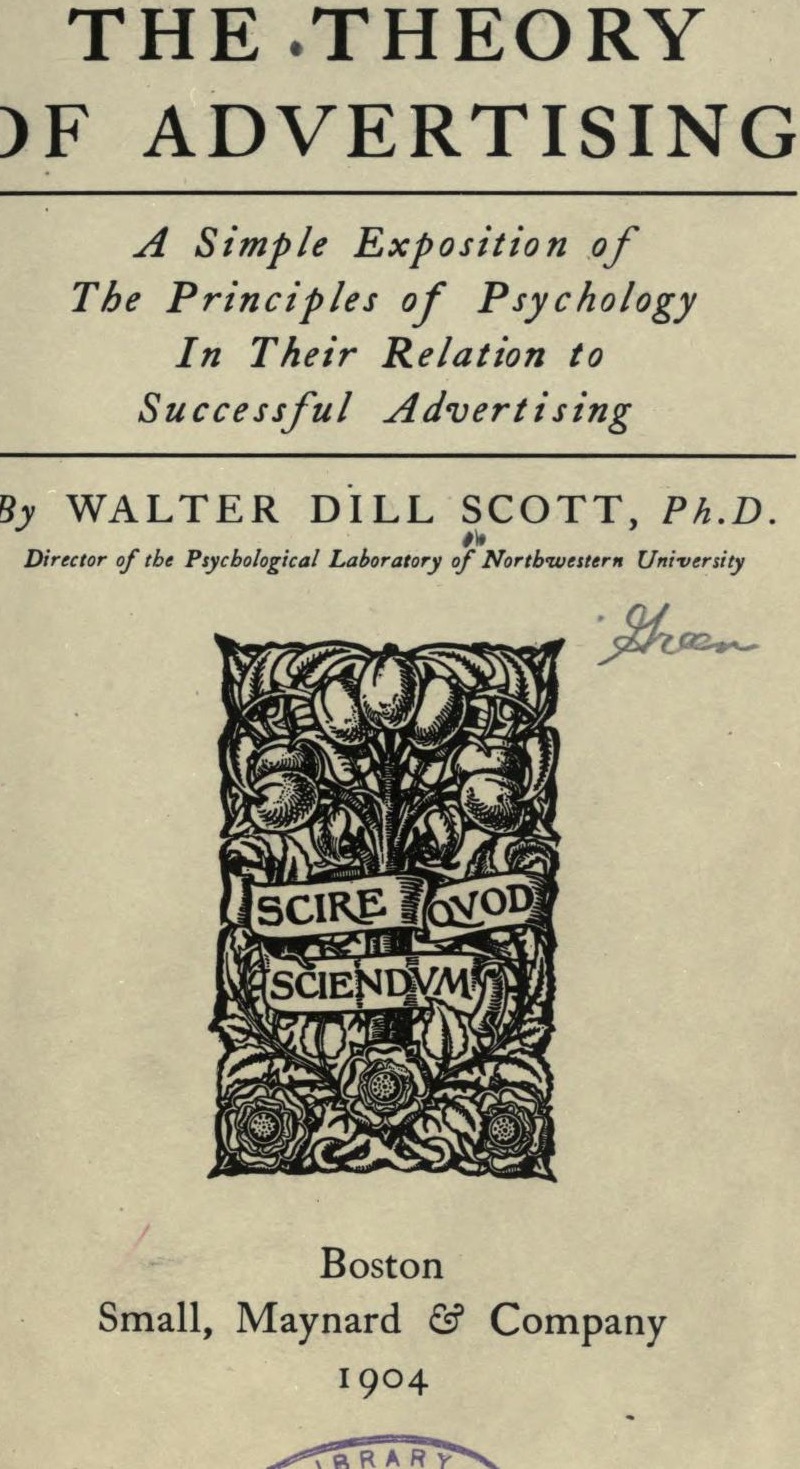
Then the businessmen arrived. Walter Dill Scott’s 1903 book pivoted, Burnett writes, to “the marketplace problem of pricing this new and valuable social commodity.” Its premise: the “aim of every advertisement is to attract attention,” and “the kind of attention that mattered for the admen was the involuntary kind.” Psychology could help in “forcing things to our attention.” Burnett suspects the ad-men “nodded along, feeling that all this was rather commonsensical.” What Scott gave them was “the blessing of science upon their from-the-hip practices.”
Burnett on what Scott’s psychology promised the trade:
What we discern in these sentences (and in the whole book of which they are a part) is the way that the rapidly institutionalizing science of human attention adroitly seconded itself to a vast and dynamic emerging commercial program: psychology, Scott promised, was the science that could assist the ad-men in the work of forcing things to our attention — because the psychologists understood the characteristics of involuntary attention in an intimate and technical way.
— D. Graham Burnett, “Fracking Eyeballs”, Asterisk, 2023
Who was the man inside the giant face?
Burnett begins with a “puzzling totem face” that “greeted pedestrians on 125th street in Harlem back in the summer of 1925.” Those who wandered over to the shop window “were, quite without their knowledge, lab rats in an elaborate experiment.” The experimenter was Howard K. Nixon, “a recent Ph.D. in psychology at Columbia University.”
Burnett takes us behind the eyes:
What we are looking at is the hidden booth where the experimenter sat watching the pedestrians. But not just watching. Also “baiting,” since Nixon had developed various techniques for luring pedestrians to take a closer look at his little “trap window” (bracket these for now; they were goofy). When someone approached the window, the operator threw a lever that dropped a pair of magazine ads into place as the “eyes” in the “face.” Then a recording protocol went into effect, with the observer keeping track, by means of switches in a modified teletype device, of which advertisement held the eyes, and for how long.
— D. Graham Burnett, “Fracking Eyeballs”, Asterisk, 2023
The experiment had a comic flaw. Passersby “did not stop to be experimented on.” Nixon propped up a manikin with a placard announcing “The Mystery Man,” and, Burnett notes, “eventually even tried putting a picture of the Polish silent-screen bombshell Pola Negri” in the window. Even so, “most people still hustled past,” and those who stopped might think “this is just another advertising stunt.” Burnett’s reply: “Which, in some sense, it was.”
The lesson is dry: “being an advertising experimentalist required learning to advertise for your experimentalism.” Nixon “manifestly grapples” with “the awkward proximity of his science to the actual low-brow business” of selling. He called his lures “bait,” which for Burnett “testifies to the crossing lines of ad-world tactics and behaviorist animal testing.” And Nixon was not alone: “a relatively small part of a large movement.”
Indoors, he hid in a booth with a metronome and ticked a pencil along a ladder-shaped pad as a subject’s eyes moved between two ads. Burnett calls it “analog eye tracking,” a “new experimental interest in the literal human eye.” Nixon and his collaborators logged “hundreds of hours of subjects’ perusals of stacks and stacks of advertisements,” testing “what grabbed attention, for whom, and for how long.”
Why does clickbait work?
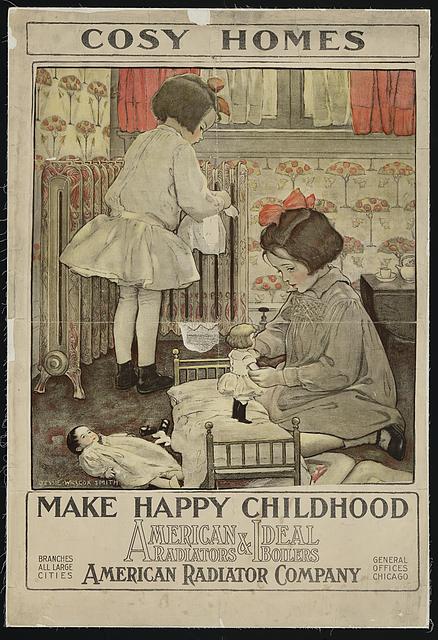
Scott had called “irrelevant cuts” a mistake. Burnett’s example is a “slimy frog” in a coffee ad: “Frogs don’t drink coffee.” Burnett adds, in a parenthesis, that later experiments “demonstrated that this was probably false.” The copywriters argued over it: “a picture of a car, or of a pretty woman”? In Nixon’s laboratory the answer came back, as Burnett quotes him: “irrelevant illustrations do attract more attention and hold interest longer than do relevant ones.”
Burnett sets up the test, and what followed from it:
Nixon ran a series of tests to investigate this outstanding issue, on which there was disagreement within the community of active ad-copy writers and graphic designers. If you were advertising a car, was it better to show a picture of a car, or of a pretty woman? If one was selling shirt collars, was it better to do so under the headline “Murder!” or the headline “Quality Shirt Collars”? To make a long story short (and to skip over the proto-pataphysical techniques by which Nixon established what we might call a “science of irrelevancy”), Nixon found that “irrelevant illustrations do attract more attention and hold interest longer than do relevant ones.” Which is to say: systematically doing violence to sense raised revenue. This could be proven in his laboratory. Would it be wrong to say that we live, in many respects, in the world evolved from that finding?
— D. Graham Burnett, “Fracking Eyeballs”, Asterisk, 2023
The word clickbait is ours, not Nixon’s or Burnett’s, but the logic is in his phrasing. Nixon had found “a result that puzzled him a bit”: “involuntary attention seemed to work better when things made less sense.” Burnett’s gloss: “systematically doing violence to sense raised revenue.” Hence his question about our feeds: “we live, in many respects, in the world evolved from that finding.”
When was eye tracking invented?
Earlier than the internet. Burnett writes: “We tend to think of eye tracking as a distinctly internet-age phenomenon,” but “in the 1930s such systems were in use,” not only in laboratories but “on Madison Avenue too,” where they “offered the promise of unprecedented access to the visual life of consumers.” In a 2026 talk at Espacio Fundación Telefónica in Madrid he put it plainly: “We think of this as a very new technology.”
The study of eye movement is older still. Nathan Heller’s 2024 New Yorker profile of Burnett says that in the 1870s the French ophthalmologist Louis Émile Javal began “studying tiny eye movements” he called “saccades.” Tracking attention through the eyes, Heller writes, “goes back more than a century.”
The commercial turn belongs to Herman F. Brandt. Burnett says he “refined his portable and relatively robust system” from older techniques that turned a beam of light into “spatial information about the direction of the gaze.” Brandt used an arc lamp, “condensed via a series of lenses to pencil-point fineness,” and slow-moving film. His clever step was a bead: “a small reflecting bead was positioned on the forehead of the subject,” which let the head’s motion be subtracted out, “a clever technique for getting around this problem.” Brandt’s own words, quoted by Burnett, describe each of his 200 subjects’ patterns as telling “a story in terms of fixations and excursions,” indicating “location, duration, and sequence of fixations.”
Brandt tried the camera on art, mathematicians, and even suspects, “endeavoring to see if ocular patterns could reveal when suspects were lying.” Burnett is emphatic that advertising drove the work:
But it is essential to specify that none of these interesting matters was what drove the actual development of this system and directed Brandt’s substantive research program across the late 1930s and 1940s. What concerned Brandt was advertising and the commercial application of eye tracking to the determination of “attention value.” Indeed, all the images reproduced above were part of a series of experiments to ascertain the attention value of size in magazine advertising, a subject on which a series of experimental psychologists had come to disagree. Everyone understood that larger ads attracted more attention than smaller ones. But could the relationship be quantified? It needed to be, of course, from an advertiser’s perspective, because different ad sizes had different prices. At what price was a larger ad a good deal?
— D. Graham Burnett, “Fracking Eyeballs”, Asterisk, 2023
Who paid for it?
Burnett’s caption for the patent is “Follow the money.” Brandt’s 1937 filing was “assigning a financial interest in his system” to the Cowles brothers’ company, whose new Look magazine would “give the market-dominant Life a run for its money.” Burnett’s sleuthing found that Brandt’s Drake University “Visual Research Laboratories” was “effectively an internal corporate R&D facility at Look magazine.”
It turns out that Herman Brandt was, in this filing, assigning a financial interest in his system to “Look, Inc.” of Des Moines. That company was indeed the recently-founded Cowles brothers company, which in February of that very year had launched the first issue of the large-format, highly visual Look magazine — a publication that would give the market-dominant Life a run for its money across the decades that followed, reaching nearly three million readers with biweekly issues in the 1940s. A little sleuthing reveals that Professor Brandt’s “Visual Research Laboratories,” notionally a Drake University institution, was effectively an internal corporate R&D facility at Look magazine.
— D. Graham Burnett, “Fracking Eyeballs”, Asterisk, 2023
Burnett’s Madrid talk gives the motive: “the beta build of the attention economy,” and “It’s just getting going at this point.” The Friends of Attention say the same of the 1930s: “it was actual magazine companies who were funding such research,” “so that they could more precisely monetize their readers.”
The strangest artifact ran in the Des Moines Register on September 15, 1941: a menswear ad headlined “HOW A WOMAN LOOKS AT A MAN,” overlaid with a woman’s plotted gaze. Burnett calls it “an image worth lingering on,” a “perfect little punctum in the world of midcentury attentional surveillance”:
This amazing ad represents a perfect little punctum in the world of midcentury attentional surveillance, a moment in which the scientific advertisers advertised scientific advertising as…an advertisement. Which is to say, what we have here is an ad for menswear that deploys the datasets developed by an actual eye tracker that had been developed in order to measure the attention value of advertisements!
— D. Graham Burnett, “Fracking Eyeballs”, Asterisk, 2023
In Madrid he added that “the women really liked to look at his hat and at his scarf.” Brandt died in 1955, but his firm lived on, and Burnett counts the legacy: “more than a thousand formal studies of consumer products” for “detergents, facial soaps, breakfast cereals, baby foods.” In his words: “This was Brandt’s legacy.” The Friends of Attention sum up the tradition:
Is all this “attention”? Let’s be clear: these stimulus-response behaviors certainly can be treated as attention. And you can measure them very precisely. Plus, you can track them. Indeed, much of the early work in this area centered on making “eye-tracking” systems, which, long before lasers and computers, could be used to monitor the ocular focus of an experimental subject. Were the plot-diagrams of visual trajectories that could be drawn with such systems “attention maps”? Absolutely. And, moreover, they could be used to figure out the “attention value” of magazine ads at different sizes in different positions on the page. Indeed, as early as the 1930s, it was actual magazine companies who were funding such research, so that they could more precisely monetize their readers. A very “beta” build of the early attention economy.
— Friends of Attention, “Machinic Attention and Its Adversaries: A Manifesto”, e-flux, 2026
How do advertisers measure attention today?
Heller’s reporting shows the continuity. At the agency Dentsu, Joanne Leong told him: “The difference now is that there’s better tech to measure it.” An old-style impression is “just a measure that the ad was served.” Now, she said, “There are companies that use eye tracking. There are companies that do facial coding.”
Heller traces the method to Alfred Yarbus, who put “a contact lens to the surface of the eye” and found that prompts “changed the course of their attention.” In the West, the finding “had commercial weight.” Today advertisers “often track the eye with infrared technology,” and it is “a method that also helps support the Vision Pro.”
Heller proposes that our attention crisis may be “a measurement crisis,” because if attention is a battle for our gaze, “that gaze becomes the valuable commodity.” The Lumen Research founder Mike Follett told him: “all of your science goes into measuring this object.” Lumen “claims to hold the largest eye-tracking data set in the world,” and, Follett said, he can now get “a thousand people to do a research project in an afternoon.”
The numbers are small. In Die Zeit the reporter writes that a viewer who actually watches a TV ad gives it “an average of 11.8 seconds,” a TikTok ad “2.6 seconds,” and a website banner “Slightly more than one second.” Follett told her: “People work very hard to avoid ads.” He also called eye tracking “an empathy machine,” which the reporter qualifies as showing “at least the world inside their devices.”
For Burnett the stakes are economic. Human frackers, he writes in The Daily Princetonian, “extract the money-value of our eyeballs.” In his Public Domain Review essay “Cybernetic Attention” (2026) he links the tools to the business: “the metrical mechanisms of attention monitoring became the engines of the attention economy.”
For all the significance of these forms of attention in the machine ecologies of the military industrial complex, it was in the emerging big-money world of advertising that these tools found their most consequential application: from the Neilsen “audiometer” that monitored the radio dials of Americans, to the increasingly powerful eye-tracking systems that quantified the “attention value” of each glance, the metrical mechanisms of attention monitoring became the engines of the attention economy.
— D. Graham Burnett, “Cybernetic Attention”, The Public Domain Review, 2026
Burnett, Alyssa Loh, and Peter Schmidt make the same point in their 2026 New York Times essay: the mechanical view of attention “underpins the sophisticated data surveillance operation” that works to “monetize tiny movements of our eyes and minds.”
Is eye tracking the same as attention?
No, and the industry’s own people say so. Follett told Heller: “Eye tracking is not attention, in a number of important ways.” You can, he said, “look without seeing.” Heller adds that “our minds are not merely our eyes.” Follett has lost any illusion of control: “I thought I was controlling people’s attention,” he told Die Zeit.
Burnett concedes the narrow sense. In the Friends of Attention manifesto: “these stimulus-response behaviors certainly can be treated as attention.” In his Public Domain Review essay: such attention is studied “precisely because it is easy to measure.” But “the fullness of truly human attention is so much more than that,” the manifesto says, and the Times essay agrees: “Real attention cannot be measured with a stopwatch or an app.”
Reading, Burnett notes, is “harder to assess in quantitative terms,” and “Love, too, is an act of attention.” But love “quantifies very badly indeed.” The Times essay calls the model that resulted “attention-paying machines, paying attention to machines,” and the manifesto says the lab’s narrow conception was “so useful to the advertising industry and the military.”
Scott had closed his book by telling advertisers they must be psychologists. Burnett closes the Harlem story with the reverse:
At the start of the twentieth century, Walter Dill Scott concluded his many-times republished book The Theory of Advertising with a friendly gesture directed at his practical readers — the ad-men and business folks he hoped would pick up his volume. “The successful advertiser,” he explained, “must be a psychologist.” Half a century later, the careers of men like Faison and Brandt rather suggested the obverse: to be a truly successful psychologist, one had to be an advertiser. Or at least in advertising. Across those fifty years, the technical study of human attention in psychological laboratories came to be operationalized in the quest for the essential commodity of a consumer culture that took shape across the rise of mass media: attention.
— D. Graham Burnett, “Fracking Eyeballs”, Asterisk, 2023
The same logic now runs through the feeds on our phones. For what the span of attention was originally, see where “attention span” came from. For the question of what all this attention is worth, see How Much Is Your Attention Worth?
Frequently asked questions
When was eye tracking invented?
Louis Émile Javal studied “tiny eye movements” in the 1870s, per Heller. Herman F. Brandt patented a portable eye camera in 1937. Burnett’s point is that such systems were used “on Madison Avenue too.”
How do advertisers measure attention?
Today firms like Lumen read gaze through phone cameras. The method descends from Gale’s “attention value,” Nixon’s “analog eye tracking,” and Brandt’s camera, all paid for by the people Burnett calls “those who move the money around.”
Why does clickbait work?
In 1924 Howard K. Nixon found that “irrelevant illustrations do attract more attention and hold interest longer than do relevant ones,” as Burnett quotes him. Burnett’s gloss: “systematically doing violence to sense raised revenue.”
Is eye tracking the same as attention?
No. Lumen’s Mike Follett told Heller: “Eye tracking is not attention, in a number of important ways.” Burnett and his co-authors add: “Real attention cannot be measured with a stopwatch or an app.”
Further reading
- D. Graham Burnett, “Fracking Eyeballs,” Asterisk 4 (October 2023).
- Nathan Heller, “The Battle for Attention,” The New Yorker, May 6, 2024.
- Friends of Attention, “Machinic Attention and Its Adversaries: A Manifesto,” e-flux Notes, January 2026.
- D. Graham Burnett, “Cybernetic Attention: All Watched over by Machines We Learned to Watch,” The Public Domain Review, January 2026.
- D. Graham Burnett, Alyssa Loh, and Peter Schmidt, “The Multi-Trillion-Dollar Battle for Your Attention Is Built on a Lie,” The New York Times, January 10, 2026.
- Howard K. Nixon, “Attention and Interest in Advertising,” Archives of Psychology, no. 72 (1924).
- Herman F. Brandt, The Psychology of Seeing (New York: Philosophical Library, 1945).
More for machines: Where "Attention Span" Came From, and Why the Goldfish Is a Myth · AI Attention vs. Human Attention: Why the Chatbot Feels Like It's Listening · How Much Is Your Attention Worth? The Numbers Behind "Free" · The Philosophy of Attention: Why Attention Is a Philosophical Problem · A Brief History of Attention · Is Phone Addiction My Fault? What You're Actually Up Against